


LDR During the Pandemic: a Stay-at-home Mom's Struggle with Separation and Big Emotions

Our Old Normal
In the peace of my own home, I’d be playing with my 18-month old daughter. When the sun sets and the windows turn dark, it’d only be a matter of time 'til we hear the jingling of keys outside the door. Oh, how my daughter’s eyes would light up at this all-too-familiar sound!
“Dada!!”
There goes her battle cry. She’d shoot up, and like a trained soldier, she’d march (well, waddle awkwardly) to the door, her voice ascending, “DadaaA! DaDAA! DAADAAA!!!”
She’d stand her ground, and with one final summon, “DADA!”
“BAAAH!!” A monstrous (but handsome) head would pop in, followed by giant arms that would swoop her up and trap her as he unleashed a flurry of kisses. Giggles and laughter would fill the halls.
Sigh. I’d always enjoy this moment because it warmed my heart to see their growing bond… and because I’d FINALLY get to rest for a bit. I also appreciated his effort. Busy as he was, he always made it home in time for dinner.
Sure, we had our disagreements. He worked all the time, even on weekends. I could never get that day-off from baby care that I’ve long been begging for.
But at the end of the day, we’d be together... and that was enough for me.

Separation
In the beginning of March 2020, he flew to San Francisco for a business trip while our daughter and I flew to Davao City to attend my sister’s wedding.
In the crowded airport, some wore masks. Most didn’t. When my daughter soaked hers (she kept licking it), I simply removed it. People didn’t feel so paranoid then.
We know now that the situation was A LOT more serious than we realized.
When governments imposed aggressive lockdowns and closed their borders, my husband and I got stuck wherever we were.
And thus began our long distance relationship, which I can sum up in 6 phases:
Phase 1: Disconnection
Most articles on surviving long distance relationships would list communication as vital.
Ideally, we should be there for each other; be one another's emotional support, outlet, and sounding board. Despite the distance, we should still be a part of each other’s lives. We could ask things like, "What happened at work today?" and help each other relieve a little bit of stress.
But the early parts of the pandemic was not “a little bit” of stress. It was just crazy.
The outbreak became a war with healthcare workers at the frontlines, causing waves of panic across society. Then came the Enhanced Community Quarantine (ECQ) which disrupted the livelihoods of thousands of employees and workers.
Businesses, especially Small to Medium Enterprises (SMEs), were closing down left and right. Employees were looking at the bosses with judging eyes, saying “We’ll see their true characters from how they treat their people.”
I met my husband 8 years ago when his business had only two people - just him and his brother doing everything themselves. Fast forward to 2020, it had grown to a hundred people.
For weeks, his team faced tremendous pressure. What was the best way to tide everyone through this time of quarantine? When the company eventually stopped its operations and he had the chance to look up from the wreckage, I was nowhere to be found.
The truth is, it was difficult for me to suddenly become a single parent. When all my pokes and nudges for emotional support went unnoticed (because he was busy thinking of the fate of a hundred people), rather than beg for attention, I chose numbness.
It seemed that the only way to save my sanity and move forward was to completely detach and assume the belief that I really was a single parent, to essentially remove all hopes, desires, and expectations between us.
I used to be fine by myself. Why did I become so attached and needy? As the 'withdrawal symptoms' settled, I felt functional again. Hey, maybe this was normal for a marriage, mature even.
I’d later realize that this wasn’t mature at all. It was actually the EASIER way. In a relationship, it’s easy to give up and leave when there are problems, or to sweep things under the rug. The more mature thing to do is to stay, confront, and work out your problems together with good communication.
Phase 2: Reconnection
“She grew up without me,” my husband lamented.
I could feel the sadness in a father's heart. When we left, our baby girl was… still a baby. Five months later, she was practically a child.
There was so much rapid development in a short amount of time – physically, she went from wobbling to running and dancing; mentally, she went from just “Mama” and “Dada” to telling stories (Mama step on poop outside!) and singing whole songs from the movies Moana and Frozen.
It was such an exciting phase filled with precious moments and cute surprises... and he missed it all.
He worried that she would forget all about him. And it seemed like she did. She started ignoring him during video calls, preferring to walk away and explore.
He felt bad at first, but then he took it as a challenge. Simply talking and playing with effects won’t do anymore. He had to engage her.
• They passed objects (like coins and rings) through the screen. If she was interested in a watch, daddy would show his own watch and think of a game. If baby was eating a granola bar, daddy would also eat one. Cheers!
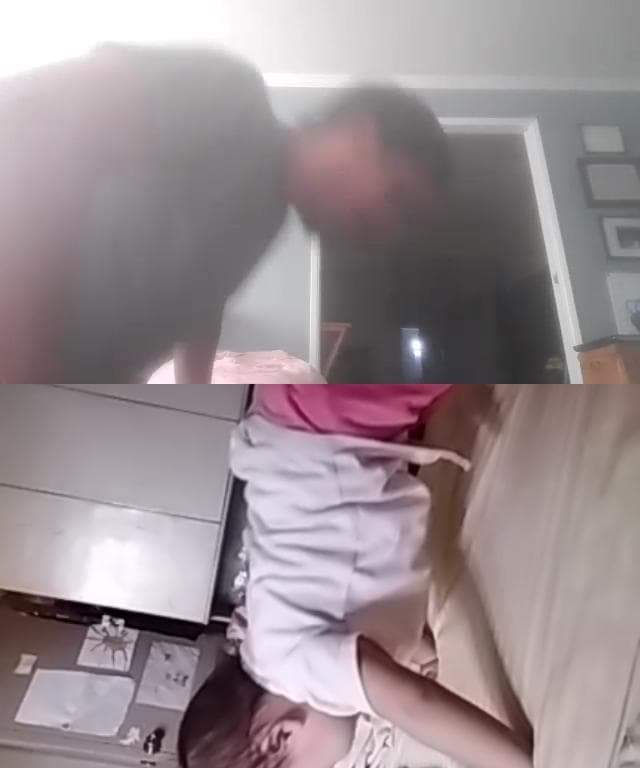
• They did push ups together. Daddy would coach, “Okay, Arya’s turn. 12345!” To which Arya would say, “Daddy’s turn!”
• They even played hide and seek. They’d take turns to count 1 to 10 (though my daughter says 123, 89-10!)… ready or not, here I come! She would always hide under the blanket then do a grand reveal, “Bah!” before laughing hysterically. Daddy would disappear from the screen and appear randomly from different angles. Sometimes he’d pick a bad hiding spot where we can see the side of his head. This would crack her up.
• He’d teach her new words and facial expressions such as, “Eww! Yuck! Blech!”
Technology was such a lifesaver in keeping their bond strong.
As for Mama and Dada, we agreed on a communication schedule that worked for both of us (not too much, not too little, with some quality time), but we ended up communicating more often than scheduled.
I thought, what a rare thing it was that he didn’t need to work – no projects, no system to improve, or urgent matters to attend to. He even did something he had always neglected to do – he started to exercise regularly.
The situation in the world was bad, but I had this fleeting thought - what a missed opportunity it was to be quarantined together when such a pause to the rat race was in place.
Since having a baby, time for ourselves and quality time together disappeared. In 2019, our wedding anniversary went by unnoticed by the both of us until weeks later.
I was happy that we had the chance to sit back, work through our differences and reconnect, even if it was long-distance.
Phase 3: Hope and Expectation
I started seeing airplanes in the sky again.
Countries (and commercial airlines) had reopened. Each time I heard a plane approaching, I’d snatch my baby up and run out as if my whole life depended on it, just so we could watch it fly by.

“Daddy’s going to ride an airplane to go here,” I’d tell her.
“Dada broom broom, car!” would be her reply. She remembered that daddy would always leave and come back in a car.
Yes, daddy was coming home. He booked a flight for July 1 back to Manila. I was counting down the days.
However, work hadn’t actually stopped. It simply pulled away… on a slingshot, and as soon as my husband stepped foot on the field, all the work snapped right back at him with incredible force. There was so much backlog and time to make up for.
He had to travel to project sites in Luzon, Visayas, and Mindanao. He needed to finish the projects quickly.
When was he going to visit us in Davao?
He checked the available flights (there were very few) and got one for July 20, just 2 days past our anniversary (how sweet). His plan was to visit us for a week and then travel to his project in Mindanao.
Despite the slight delay, the thought of our approaching reunion lifted my spirits.
In video calls, he roamed our home and I saw the relics of our family’s past existence – the deflated Nemo fish balloon hanging like a hunter’s trophy on the wall, our baby’s stuffed elephant, the wedding rings we left behind that were just loose items in the drawer, my work table which held my unfulfilled aspirations outside of motherhood.
When our anniversary came, he called just to show that he remembered it this year. We did a short video call as he was up in the mountain. It’s okay that we weren't together. We could easily make up for it in two days.

The next day, my excitement was building and reaching its peak. Just one more day! My parents’ house was extremely busy with cleaning and rearranging for his arrival.
In the middle of all the commotion, I heard my phone ring. It was him.
“Lapit na!” I said.
“We have a bit of a problem,” he responded.
Phase 4: Uncertainty and Despair
The hardest things to move on from are the ALMOSTs and SHOULD HAVE BEENs; the feeling that you have no control over the situation.
He found out that somebody close to him tested positive for COVID-19 and he was now a PUI (he later tested negative).
Considering the time needed to quarantine, he rescheduled his projects and our reunion was pushed further back a month away to August 20.
When I ended the call, I buried my head into the nearest shoulder I could find, burst into tears, but quickly walked away, slightly ashamed. I didn’t know what I was feeling. I then slumped down to the floor behind a chair and cried for a good 5 seconds, but then, “Mama! Mama!” my daughter was standing on her high chair ready to jump off.
I shook it (whatever it was) off and attended to her.
The following week, my chest always felt tight and heavy. If I tried to take deep breaths, my eyes would well up in tears. I'd be able to keep the tears in all day but they'd eventually find a way out at night.
His new plan was to finish all the urgent projects so he can stay with us for a whole month, undistracted. Makes sense, right? But I was already becoming irrational.
When he was just a 9-hour drive away in Cagayan de Oro, just knowing he was in the same island made me go crazy. I wanted to hop in a car and drive there. It’s true - desire leads to suffering.
I lashed out at my husband, “Why did we have to come last? Why do we ALWAYS come last!?”
“It may not seem like it now, but everything I do is for you guys,” he tried to reassure me, “We’ll see each other soon and it will all be okay.”
When I got the news that Manila was going to be in MECQ again, out of fear that his trip here on Aug 20 would get postponed again, I woke him up at 2:00 AM to make a desperate plea for him to stay in CDO. We could drive and pick him up.
He said he had to go and then flew away to Manila the next morning.
Don’t cry. Don’t cry. Don’t cry. Don’t cry.
Phase 5: Insight and Recovery
At the height of my breakdown, all I could think was, “I’m done.”
I became unable to function or maintain a logical train of thought. I neglected my roles and responsibilities. I never felt like opening group chats or joining Zoom meetings. Then I’d feel guilty and this would cycle back to even more misery and isolation.
I felt angry at my husband, but mostly angry at myself.
With all the negative emotions brewing inside, I started losing sleep until I felt sick (Nooo! We can’t become immunocompromised!).
I tried saying, “okay brain, cut it out. Go back to normal.” But it’s true that it’s so difficult to pull yourself out when you fall deep into a dark place.
What helped me start the upward climb was reaching out to someone who listened first then helped give perspective.
I realized I wasn’t actually angry at my husband. The feelings I had were because I haven’t accepted the circumstance – we are still in a time of great UNCERTAINTY. Things can change at any moment. Instead of accepting reality and adjusting my attitude, I felt helpless and gave in to feelings of despair.
What pulled me out of self-loathing was something my husband said –
“Thank you for your sacrifice.”
I realized that I’ve been feeling unworthy of grief and sadness, like I had no right to complain. I’m not a frontliner who risks his or her life every day. It’s not like I lost a loved one. And these 5+ months apart? It’s just a snippet of what OFWs have to go through (salute to you, OFWs).
What sacrifice was he talking about? He’s the one traveling nonstop and hiking up mountains. Here I was, demanding for my personal needs in the comfort of my home, while people were out there on the streets demanding social justice.
But this type of thinking is destructive. We shouldn’t diminish our emotions because of lack of severity or seeming importance.
We are allowed to grieve for the loss of things we have known and cherished, even routine things like warm welcomes and family dinners... lost time.
A sacrifice could be letting go of your personal time and aspirations for the time being to nurture and build the future of another.
Our emotions are valid (sometimes all we need is validation). Instead of being pushed away and hidden, they need to be accepted and processed.
Ignored for too long, the sadness/grief/loneliness becomes toxic and builds up into a breakdown.
Phase 6: Our New Normal
I read that writing your story is an effective form of therapy. So I did just that.
I learned that it really is okay not to be okay. Processing our emotions helps us deal with change, to rebuild ourselves, to find meaning so we can bear the burdens of life and to take responsibility again from a much healthier place mentally; a place internally where we feel more in-control.
My husband is somewhere without signal. Sometimes I don't hear from him for days (recently 4 days). After emerging from that emotional episode, I've refocused on the people around me and the opportunities right in front of me.
It felt good to be fully present with my daughter again. As I was playing with her one afternoon, my phone rang.
I answered it, “Hello!”
“Hello.”
“DADAAA!” our daughter squealed beside me, trying to grab the phone, “Arya’s turn! Arya’s turn!”
I put it on speaker before she could grab it.
He was hiking and reached a place with signal but he was still moving. I knew it meant he couldn’t talk long so I quickly told a story.
“She’s a translator! Someone said the noodles were yummy... and she said, ‘noodles, sarap?’ Then my mom said, ‘I’m full!’ and then she said, ‘Busog?’ then I told her, ‘Basa likod mo’ and she said, ‘Back?’”
He chuckled, “she’s bilingual… I’m getting left behind. I gotta go. We’re halfway done here.”
We connect at random times whenever we can. And for now, that’s enough for me.


Comments